Summary
The how to play sungka: basic rules and introduction for beginners is one of the questions that Filipinos continuously search for — and for a good reason. Sungka is one of the most popular traditional Filipino games that has survived...
Table of contents
- 1 What is Sungka and Where Did It Come From
- 2 How to Play Sungka: Basic Rules and Board Setup
- 2.1 How the Pieces Move
- 2.2 Special Rule: The “Capture” or Taking the Opponent’s Pieces
- 3 Basic Rules of Sungka for Beginners
- 4 How the Game Ends and How to Determine the Winner
- 5 Equipment and Materials to Play Sungka
- 6 Common Variations of Sungka in the Philippines
- 7 Basic Strategies for Beginners
- 8 Sungka as Part of Filipino Culture
- 9 Frequently Asked Questions about Sungka (FAQ)
- 9.1 How many players are needed for sungka?
- 9.2 How many pieces are needed to play sungka?
- 9.3 Can the first player always win?
- 9.4 What happens when all the holes of one player are empty?
- 9.5 Can you make a sungkaan at home?
- 9.6 What is the difference between sungka and other mancala games?
- 10 Your Next Step
- 11 References
The how to play sungka: basic rules and introduction for beginners is one of the questions that Filipinos continuously search for — and for a good reason. Sungka is one of the most popular traditional Filipino games that has survived the test of time, from coconut groves to modern living rooms. According to Wikipedia Tagalog, sungka belongs to the broader family of mancala games — a type of game played in Indonesia (Borneo), Singapore, and Malaysia, and is also known in some countries under the names Tchonka, Naranj, and Dakon. This article will guide you from the most basic setup to the first completed match.
What is Sungka and Where Did It Come From
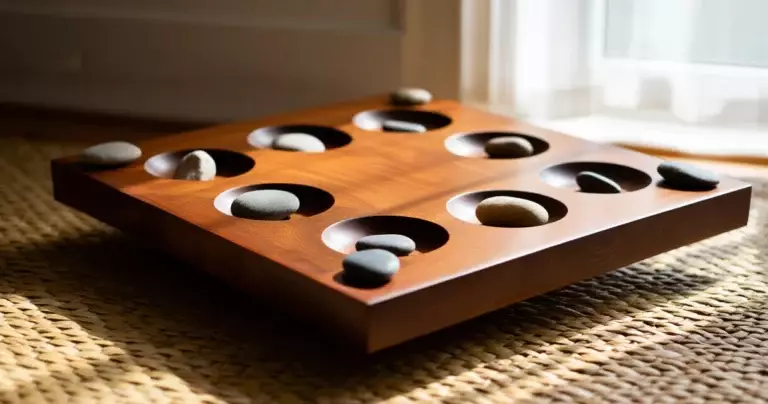
Sungka is a board game that uses a sungkaan — a game board that belongs to the global family of mancala games. According to Wikipedia Tagalog, this game is known and played in Indonesia (Borneo), Singapore, and Malaysia, and has been a part of Filipino culture long before the Spaniards arrived. The word “sungka” itself comes from the local language, and traditional boards are made of wood or stone, shaped like a boat with two rows of holes. The history of mancala as a group of games dates back to ancient civilizations in Africa and Asia, proving that this type of strategy game is one of the oldest types of games in the world.
How to Play Sungka: Basic Rules and Board Setup
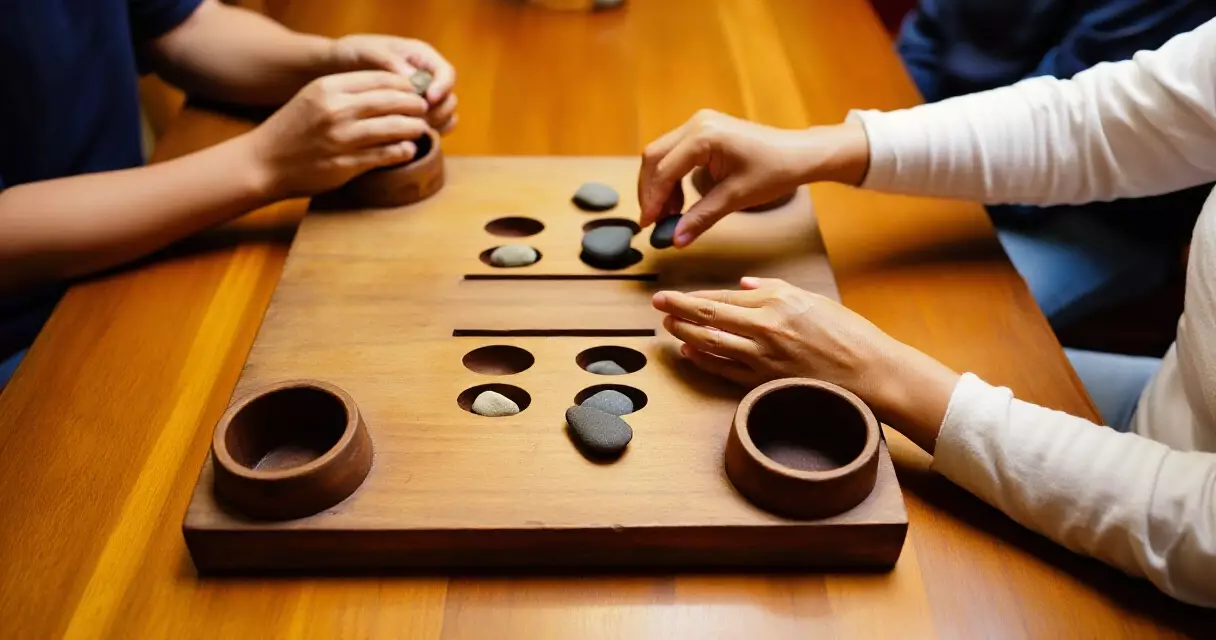
Before starting the game, it is essential to understand the correct setup. According to explanations on Brainly.ph and well-known tutorials, here is the proper way to prepare:
- Lay the sungkaan horizontally between the two players.
- Each player has their own 7 small holes on their side — this is their “territory.”
- At both ends of the board are the two large holes or storage areas (called “home” or “store”). These are empty at the start.
- Fill all 14 small holes with four pieces each (stones, shells, or small beads) — a total of 56 pieces on the entire board.
- Decide who will start; you can play rock-paper-scissors or flip a coin.
How the Pieces Move
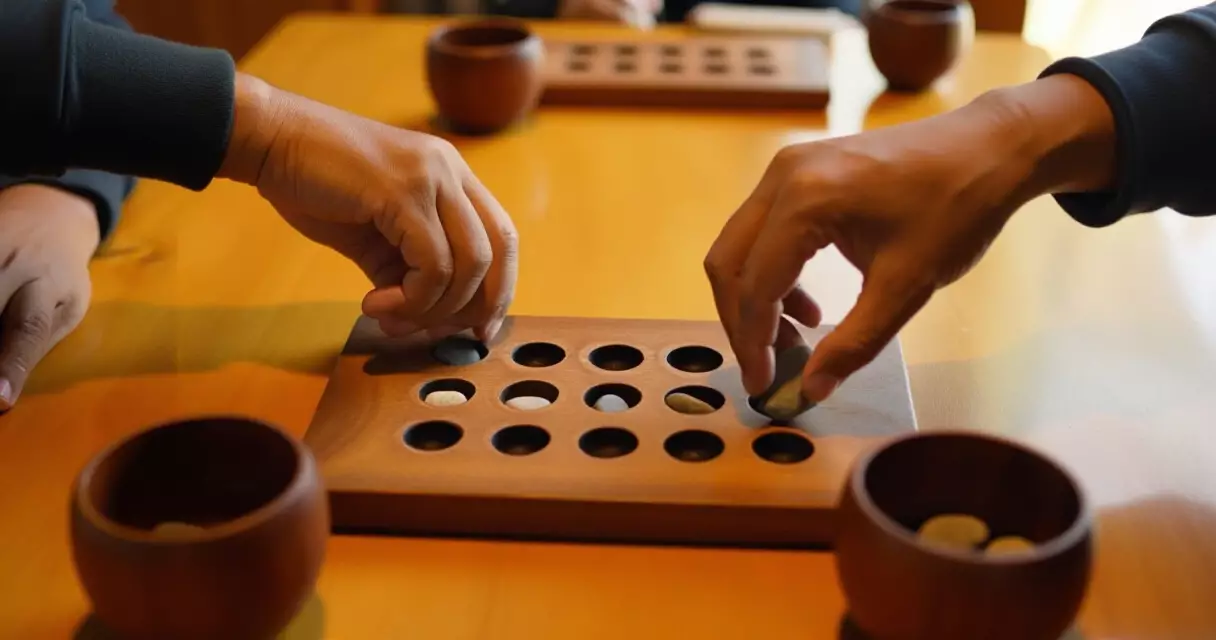
When it’s a player’s turn, they choose a hole on their side and take all the pieces from there. Then, they distribute those pieces one by one into each subsequent hole in a circular direction (counter-clockwise is commonly used, depending on local rules) — including their own storage when they reach it, but not the opponent’s storage. The opponent’s holes receive pieces during the journey, but the opponent’s storage is skipped.
Special Rule: The “Capture” or Taking the Opponent’s Pieces
This is one of the most exciting parts of sungka for beginners. If the last piece you drop lands in an empty hole on your side, and the hole on the opposite side of the opponent has pieces, you can take all the pieces from the opposite hole and place them in your own storage. This is called the “capture” move — an important strategy that provides a significant advantage.
Basic Rules of Sungka for Beginners
Here is a summary of the basic rules you need to know before playing sungka:
| Rule | Details |
|---|---|
| Objective of the game | Collect the most pieces in your own storage before the opponent runs out of moves |
| Direction of movement | Counter-clockwise (circular) in the usual version; some local variants use clockwise |
| Own storage | Receives pieces when your run reaches it |
| Opponent’s storage | Skipped — you cannot add pieces there |
| Extra turn | If your last piece lands in your own storage, you play again |
| Capture / Nakaw | Last piece in your empty hole + contents in the opposite = you take the contents of the opposite |
| End of the game | When all 7 holes of one player are empty; remaining pieces on the other side go to the owner’s storage |
| Counting the winner | Count the contents of each storage; the one with the most pieces wins |
How the Game Ends and How to Determine the Winner
The game of sungka ends when all 7 small holes of one player are empty — no more pieces can be taken for a move. At this point, the pieces still in the 7 holes of the other player automatically go to the storage of the owner of those holes. After this, each player counts the contents of their storage. The one with the most pieces wins. In total, there are 56 pieces on the board (14 holes × 4 pieces), so the winning player must have more than 28.
“Sungka is not just a game of chance — it is a game of thought. The player who thinks two steps ahead always has the advantage.”
Equipment and Materials to Play Sungka
To play sungka, you only need two main things:
- Sungkaan (board): The traditional sungkaan is made of wood, with 14 small holes and 2 large holes at each end. It can be found in toy stores, markets, and online shops in the Philippines. Some use a DIY version made from cardboard or boxes.
- Pieces: Traditionally, small stones, mussel or clam shells, or fruit seeds (like tamarind seeds) are used. In the modern version, small stones, marbles, or beans can be used.
For those who want to try the digital version, there are now several mobile apps and online versions of mancala — the most accessible are the mancala apps on the Google Play Store with sungka-style rules, although these are mostly international mancala rules and may have slight differences from the traditional Filipino version. If you want to play with friends online, check out our list of best co-op mobile games for friends 2026.
Common Variations of Sungka in the Philippines
Like many traditional games, sungka has different variations depending on the region and family. According to explanations on Pilipinas Bigwas, players may vary the direction of movement (clockwise or counter-clockwise), the number of pieces at the start, or special capture rules. Here are some of the most common variations:
| Aspect | Classic Version | Common Variation |
|---|---|---|
| Pieces at the start | 4 per hole (56 total) | 5 or 7 per hole |
| Direction | Counter-clockwise | Clockwise (depending on the area) |
| Capture rule | Last piece in empty hole = capture | Some versions have no capture rule |
| Extra turn | Last piece in own storage = extra turn | Equal turns in other versions |
The most important thing before starting the game: agree first on which variation to use. Especially when there are guests or if one is unfamiliar with the game, clearly set the rules before starting.
Basic Strategies for Beginners
Knowing the rules is not enough — a bit of strategy is also needed to make your game more effective. Here are the most basic tips that any beginner can do:
- Look for the extra turn: Always check if you have a hole that, when you take its contents, the last piece will end up in your storage. The extra turn provides a significant advantage.
- Plan the capture: See if you have an empty hole and the opposite hole has contents — this is the most profitable move.
- Do not let your holes run out of contents too early: If all your 7 holes are empty, the game is over, and the opponent will take all the remaining pieces on their side.
- Focus on holes near your storage: It is easier to control pieces that are close to your storage than those far away.
Sungka as Part of Filipino Culture
More than just a game, sungka is an important part of Filipino culture. It is one of the games that bring families closer and enhance the intelligence of the youth — which is why it is often included in school curricula as part of cultural dissemination. According to Wikipedia Tagalog, sungka has related forms in various parts of Southeast Asia, showing the deep connection of Filipino culture to the broader region. Nowadays, many teachers and parents are reintroducing sungka as an alternative to screen-based entertainment for children.
“With every piece shared in sungka, there is a small lesson about conserving strength, planning, and being ready for the next step.”
For those who wish to learn more about the deeper history of traditional Filipino games and how they have evolved in the digital age, read our How to Play Sungka: Basic Rules and Simple Win Primer.
Frequently Asked Questions about Sungka (FAQ)
How many players are needed for sungka?
The classic sungka is for two players. Each has their own 7 holes and a large storage on their right end. There is no official multiplayer version of traditional sungka, although groups may create their own rules for more than two players.
How many pieces are needed to play sungka?
In the classic setup with four pieces per hole, a total of 56 pieces are needed. Some versions use 5 (total of 70) or 7 (total of 98) pieces per hole. Traditional pieces are small stones, shells, or fruit seeds — any small and uniform item will do.
Can the first player always win?
Not always. Unlike other games, sungka has enough strategic depth that the second player has an equal chance. The first player has a slight advantage at the start, but the right capture and extra turn strategy of the second player can change the entire course of the game.
What happens when all the holes of one player are empty?
When all 7 small holes of one player are empty, the game immediately ends. The pieces still in the 7 holes of the other player automatically go to the owner’s storage of those holes. After this, the contents of each storage are counted to determine the winner.
Can you make a sungkaan at home?
Yes, it is easy to make. You can use thick cardboard or a box, and create 14 small holes and 2 large holes at each end. You can also use egg cups as holes. For the pieces, stones or fruit seeds can be used. Many tutorials on YouTube show step-by-step DIY sungkaan making.
What is the difference between sungka and other mancala games?
Sungka is a specific Filipino and Southeast Asian version of mancala. The main difference from international mancala (Kalah) is the board layout (7 holes per side in sungka compared to 6 in Kalah), and some specific local capture and extra turn rules. The sungkaan itself — the wooden board — is known throughout Southeast Asia under different names.
Your Next Step
How to play sungka is not difficult to learn — within ten minutes, you will have enough knowledge to start. The basic rules and introduction for beginners are these: set up the board, choose a hole, distribute the pieces, and watch your storage. Strategies like capture and extra turn will naturally be learned as the game progresses.
For a deeper study of winning strategies, as well as tips for more advanced play, visit our guide to modern sungka and dama tips 2026. And if you want to know how other players use mobile games to enhance strategic thinking, read our Top 5 Most Downloaded Mobile Games in the Philippines 2026.
References
- Sungka — Wikipedia, the free encyclopedia — accessed on August 13, 2026
- How to play sungka — Brainly.ph — accessed on August 13, 2026
- Sungka — Pilipinas Bigwas — accessed on August 13, 2026