
Summary
According to a 2025 study published in the International Journal of Advanced and Applied Sciences, the number of Filipino children playing traditional street games continues to decline as mobile and online gaming becomes more popular. This raises an important question...
Table of contents
- 1 What are the 5 Filipino games?
- 2 A Brief History of Filipino Games Before the Digital Age
- 3 Patintero: The King of Filipino Street Games
- 3.1 How to Play Patintero
- 3.2 Tips for Excelling at Patintero
- 4 Tumbang Preso: Strategy, Speed, and Slippers
- 5 Luksong Tinik: A Test of Leg Strength and Courage
- 6 Piko: The Filipino Version of Hopscotch
- 7 Sipa: The Former National Game of the Philippines
- 8 Comparison of Traditional Filipino Games in a Table
- 9 Why Are the 5 Filipino Games Still Important in 2026?
- 10 How to Reintroduce These Games to Children
- 11 Frequently Asked Questions About the 5 Filipino Games
- 11.1 What was the national game of the Philippines before 2009?
- 11.2 How many players are needed for patintero?
- 11.3 Are traditional games better than mobile games?
- 12 Conclusion: Filipino Games Should Not Be Lost
- 13 References
According to a 2025 study published in the International Journal of Advanced and Applied Sciences, the number of Filipino children playing traditional street games continues to decline as mobile and online gaming becomes more popular. This raises an important question for us on June 21, 2026: which of the classic games should we revive and take pride in? In this guide, we will look at the 5 Filipino games that brought joy to generations of Filipinos — patintero, tumbang preso, luksong tinik, piko, and sipa — as well as their history, mechanics, and practical tips for playing them again.
Beyond nostalgia, these games have deep cultural, health, and social interaction values. At Laro Hub, we believe that the love for modern gaming is not far from the respect for its origins. Therefore, this article will prepare you from simple instructions to the current state of traditional games in the country.
What are the 5 Filipino games?
When we say 5 Filipino games, it usually refers to the most popular and easiest traditional games that are part of what is called laro ng lahi. According to Wikipedia, traditional Filipino games are games commonly played by children using local materials such as cans, slippers, stones, or rubber. For this guide, we chose five games that almost every Filipino has memories of: patintero, tumbang preso, luksong tinik, piko, and sipa.
Why were these five chosen? First, they do not require expensive equipment, making them accessible to every barangay. Second, they reflect different skills: strategy, speed, strength, balance, and control. Third, they are easy to teach and play in any open space. At this point, it is important to know that more than thirty-eight types of traditional games are recorded in various references, but the 5 Filipino games we will discuss are the most widely recognized.
- Patintero — a game of strategy and speed between two groups.
- Tumbang preso — a game of throwing and running using a can and slippers.
- Luksong tinik — a jumping game that tests leg strength.
- Piko — the Filipino version of hopscotch that showcases balance.
- Sipa — a game of foot control using a sipa or washer with rubber.
A Brief History of Filipino Games Before the Digital Age
Before the arrival of consoles and smartphones, the streets, yards, and plazas were the playgrounds of Filipino children. These games were passed down orally and through practice, from the older generation to the younger, over many generations. One of the most famous examples of this importance is sipa. According to records from Wikipedia, sipa was considered the national game of the Philippines until 2009, a testament to its deep roots in our culture.
It is important to compare this past with the present. Over the past decade, digital entertainment has grown rapidly. This can be seen in the list of most downloaded mobile games in the country, where almost all young people have a favorite app game. This is not bad, but it has led to a decline in the practice of traditional street games, a change identified by researchers as a cultural issue.
Based on available data from the International Journal of Advanced and Applied Sciences, there is a continuous change in the recreational choices of Filipino youth, showing a decline in games like patintero and luksong tinik. This is why understanding, documenting, and replaying these 5 Filipino games is more important now.
Patintero: The King of Filipino Street Games
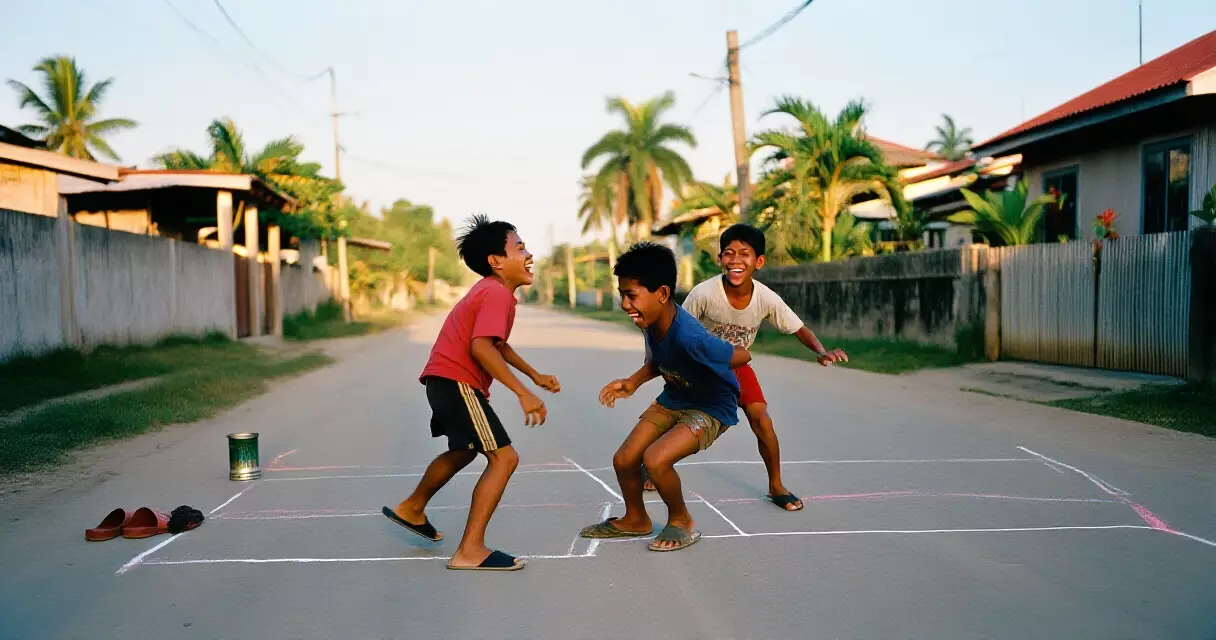
Patintero, also known as harangang taga or tubigan, is probably the most iconic traditional game in the country. According to Wikipedia, its name comes from the challenge of “try to cross my line without me touching you.” Two groups play: the attackers and the defenders, usually with five players on each side.
How to Play Patintero
Draw a rectangle on the ground divided by lines. The defenders stand on the lines and cannot leave them, while the attackers must cross from front to back and return without being tagged. If an attacker is touched, the two groups switch roles. The winning group is the one that crosses completely without being caught.
Tips for Excelling at Patintero
- Use fake moves before running to confuse the defender.
- Work as a team; when one distracts, another should cross immediately.
- For defense, keep hands ready on both sides of the line.
Tumbang Preso: Strategy, Speed, and Slippers
Tumbang preso is one of the most affordable games because it only requires a can and slippers. According to recorded references, the game has three roles: the taya who guards the can, the player assigned to the can, and the players who throw. The aim of the throwers is to knock down the can using their slippers while avoiding being caught by the taya.
The beauty of tumbang preso is the mix of strategy and speed. You need to gauge when to hit the can and when to retrieve your slipper without getting caught by the taya. Every time the can falls, players have the chance to retrieve their slippers. Because of this, it is a game that teaches proper timing, patience, and perseverance.
Today, tumbang preso is often seen in school cultural programs and festivals. This proves that the game is still alive despite changing times, especially with proper guidance from teachers and parents.
Luksong Tinik: A Test of Leg Strength and Courage
Luksong tinik, which means jumping over “thorns,” is a game of strength and flexibility. According to Wikipedia, two players serve as the base; they join their feet and hands to form a progressively higher “thorn.” The other players must jump without touching the base.
This game has a close relative called luksong baka. In this version, one player bends over as the “cow,” and others jump over them. As time goes on, the bent player gradually rises, making the jump more difficult. According to records, this is the Filipino equivalent of the game Leapfrog. In both versions, leg strength, proper timing, and courage are essential.
Piko: The Filipino Version of Hopscotch
Piko is the Filipino version of hopscotch, where boxes are drawn on the ground and a player throws a marker. The goal is to throw the marker into the correct box, then hop through the boxes without stepping on the lines or losing balance. According to gathered references, the player who throws the marker closest to the agreed spot plays first.
Although simple, piko tests balance, concentration, and coordination. It was often a game for young girls in the past, but it is open to everyone. Since it only requires chalk and open ground, it is one of the easiest games to bring back to schools and communities in 2026.
Sipa: The Former National Game of the Philippines
Sipa is a game where the sipa is kept airborne using only the foot or knee. According to Wikipedia, the sipa should not touch the ground, and the number of kicks is counted; the player with the most kicks wins. As mentioned, sipa was the national game of the Philippines until 2009, so it holds a special place in our recreational history.
Sipa demonstrates the connection between traditional games and modern competition. As organized sports grow, including major international competitions like the Esports World Cup 2026, sipa shows that the heart of competition has long been part of the Filipino identity. From a simple washer with rubber to formal sepak takraw, this game continues to evolve.
Comparison of Traditional Filipino Games in a Table
To better see the differences between the five games, here is a comparison table based on the common ways of playing recorded in Wikipedia and other references. Note that the number of players may vary depending on the location and agreement.
| Game | Typical Number of Players | Equipment | Main Skills |
|---|---|---|---|
| Patintero | 10 (two groups of 5) | Drawn lines on the ground | Strategy and speed |
| Tumbang preso | 3 or more | Can and slippers | Timing and running |
| Luksong tinik | 4 or more | Hands and feet only | Strength and flexibility |
| Piko | 2 to 6 | Marker and drawn boxes | Balance and coordination |
| Sipa | 1 or more | Sipa or washer with rubber | Foot control |
Aside from mechanics, it is also noticeable how each game shapes different skills, both physical and social. Here is a second table summarizing these benefits.
| Game | Physical Skills Developed | Social Lessons |
|---|---|---|
| Patintero | Speed and agility | Teamwork |
| Tumbang preso | Arm accuracy and strength | Patience and timing |
| Luksong tinik | Leg strength | Courage and trust |
| Piko | Balance and control | Concentration |
| Sipa | Foot-eye coordination | Discipline and perseverance |
Why Are the 5 Filipino Games Still Important in 2026?
Despite the growth of digital gaming, there is a strong reason why the 5 Filipino games should remain alive. First, they are an inexpensive form of exercise that does not require electricity or the internet. Second, they teach face-to-face social interaction, something that is gradually diminishing in the screen era. Third, they are part of our identity as Filipinos.
There are institutions that continue to promote them. The Department of Education has long been advocating the Laro ng Lahi program to include traditional games in the physical education of students. Its goal is to strengthen cultural appreciation while encouraging an active lifestyle among children.
The cultural sector is also not left behind. Just as modern gaming is celebrated at events like the Good Game Con 2026, there are also increasing community festivals and barriolympics showcasing tiyakad, sungka, sipa, and luksong tinik. This shows that both old and new forms of play can thrive together in our country.
In terms of preservation, the National Commission for Culture and the Arts continues to promote the documentation and promotion of traditional games. With the help of digital methods, it is easier to share knowledge about these games with tech-savvy youth.
How to Reintroduce These Games to Children
Preserving the 5 Filipino games is not just the job of the government; it starts at home and in the community. Here are some practical steps that parents, teachers, and local leaders can take to revive traditional games.
- Provide a safe space like a covered court or open yard for recreation.
- Include traditional games in school programs and barangay fiestas.
- Make the activity intergenerational; let the older teach the younger.
- Use social media to share videos of gameplay and instructions.
- Set small games or barriolympics as regular events.
It is also important not to pit old and new recreation against each other. Just as the game changes in modern titles being followed like the MLBB meta 2026, the way traditional games are presented also continues to evolve. The key is balance: give children the opportunity to experience the joy of playing outside, alongside their interest in digital gaming.
Frequently Asked Questions About the 5 Filipino Games
What was the national game of the Philippines before 2009?
According to Wikipedia, sipa was considered the national game of the Philippines until 2009. This is one of the strongest proofs of the value of traditional games in our culture.
How many players are needed for patintero?
Patintero is usually played by two groups of five, according to Wikipedia, so about ten players are ideal. However, the number can be adjusted depending on the size of the space and the number of participants.
Are traditional games better than mobile games?
It is not a matter of which is better, but of balance. Traditional games have unique benefits for physical health and face-to-face interaction, while digital gaming offers other skills and connections. Both are part of the vibrant gaming culture in the Philippines.
Conclusion: Filipino Games Should Not Be Lost
The 5 Filipino games we discussed — patintero, tumbang preso, luksong tinik, piko, and sipa — are more than just simple pastimes. They are lessons in social interaction, physical exercise, and connection to our origins. In the face of the rapid growth of digital entertainment, as proven by data from the International Journal of Advanced and Applied Sciences in 2025, the need to preserve these games becomes more urgent.
- The five games are affordable, easy to play, and reflect various skills.
- Sipa was the former national game until 2009, according to Wikipedia.
- There is support from DepEd and NCCA for preserving traditional games.
- They can be revived through space, programs, and intergenerational cooperation.
At Laro Hub, we encourage you to try one of these games again with family or friends in 2026. With every crossing in patintero or throw in tumbang preso, it is not just a game; it is the continuation of a rich tradition that originated with us and should remain with us.
References
- Traditional games in the Philippines — Wikipedia — retrieved June 21, 2026
- Traditional Filipino games in a digital world (IJAAS, 2025) — retrieved June 21, 2026
- Department of Education (DepEd) — retrieved June 21, 2026
- National Commission for Culture and the Arts (NCCA) — retrieved June 21, 2026